

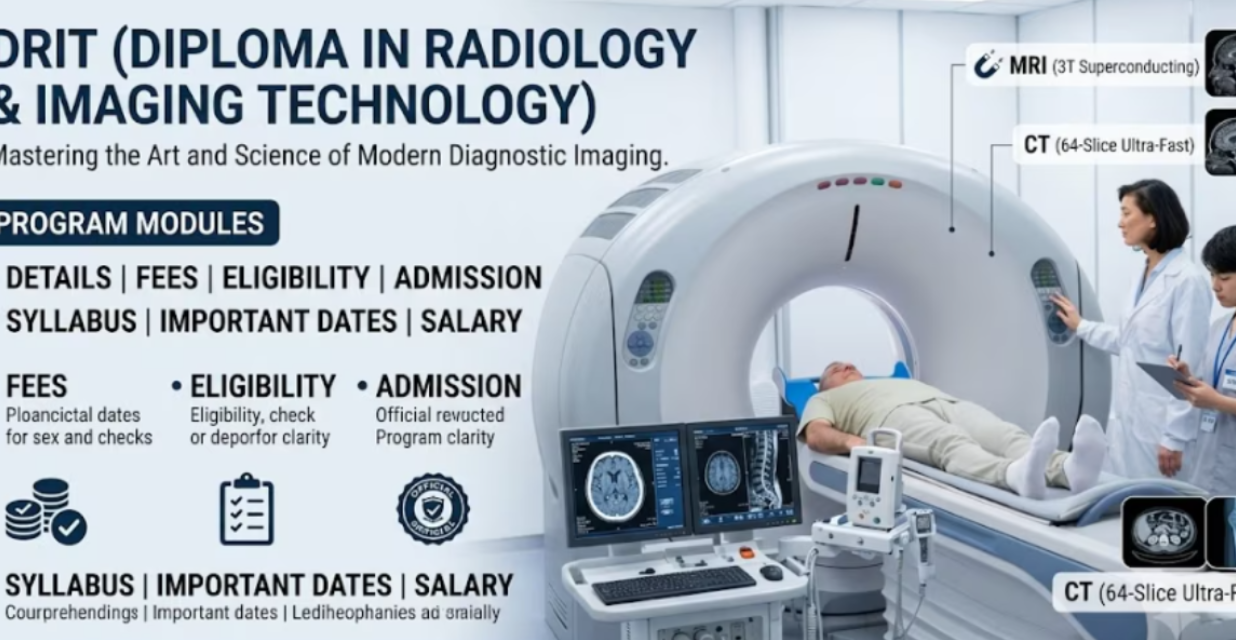
Students interested in diagnostic imaging frequently encounter courses with names such as Diploma in Radiology and Imaging Technology, Diploma in X-Ray Technology and Radiology Technician programs. Although these titles may sound similar, their duration, academic depth and practical coverage can be different.
Understanding these differences helps students avoid selecting a course based only on its name. KP Paramedical Institute provides information about imaging-related paramedical programs for learners in PCMC who want to compare available pathways carefully.
What Is a DRIT Program?
DRIT commonly refers to a Diploma in Radiology and Imaging Technology. It generally introduces learners to imaging principles, patient positioning, equipment awareness and radiation-safety practices.
Depending on the syllabus, a DRIT program may cover:
- Anatomy and physiology
- Fundamentals of radiographic imaging
- X-ray equipment
- Patient preparation and positioning
- Image formation and processing
- Radiation physics
- Radiation protection
- Contrast-study awareness
- Infection-control practices
- Departmental documentation
- Introductory concepts related to advanced imaging
- Professional conduct
Program content varies between institutions and awarding authorities. Students should request the latest syllabus before applying.
How Is an X-Ray Technology Course Different?
An X-Ray Technology course generally focuses more closely on conventional radiography. Students may learn about X-ray equipment, standard positioning techniques, image acquisition and radiation protection.
A DRIT program may provide a broader introduction to radiology and imaging. It could include conventional X-ray procedures alongside basic concepts associated with other diagnostic imaging modalities.
The main differences may include:
- X-Ray Technology courses usually emphasise conventional radiography.
- DRIT programs may introduce a wider range of imaging concepts.
- Both should provide radiation-safety education.
- Both require patient-positioning practice.
- Practical exposure depends on the individual institute.
- Career eligibility depends on qualification recognition and employer requirements.
Neither course is automatically better. The right choice depends on the learner’s goals, the qualification level and the actual curriculum.
Does DRIT Provide Training in CT and MRI?
Some DRIT syllabuses may introduce CT, MRI and other imaging modalities. However, introductory theory does not necessarily prepare or authorise a graduate to operate every imaging system independently.
Advanced imaging equipment involves specialised procedures, institutional protocols and specific recruitment requirements. Students should ask whether each modality is covered through classroom instruction, demonstration or supervised clinical practice.
Be cautious of claims that a short course creates immediate expertise across all imaging technologies.
Admission Questions Students Should Ask
Before enrolling, verify:
- What is the complete qualification name?
- Is it a certificate, diploma or degree?
- What are the eligibility requirements?
- Who conducts the examination?
- Is the qualification appropriately recognised?
- Which subjects are included?
- What equipment is available for practical learning?
- Is clinical exposure provided?
- How is radiation safety taught?
- Is an internship included?
- What are the total fees?
- Can the qualification support further study?
Students should obtain important answers in writing.
Selecting the Right Imaging Course in PCMC
A student mainly interested in conventional radiography may consider a focused X-Ray Technology course. A learner seeking broader introductory knowledge may find a DRIT program more aligned with their interests.
PCMC is connected to the wider healthcare and diagnostic network of Pune, Maharashtra. Local access can make education more convenient, but convenience should not replace verification.
A suitable imaging technology program should provide transparent qualification details, practical learning, patient-safety instruction and strong radiation-protection awareness. Comparing these elements can help PCMC students choose a course based on its actual educational value rather than its title alone.