

A laboratory result becomes trustworthy only when each step is controlled, from identifying the patient and selecting the tube to verifying the report and disposing of waste. By the end, you will know which DMLT practical skills to look for, how competence is demonstrated, and how to compare training options in the PCMC area.
Key takeaways
- Match the patient, requisition form, tube label and test before collection.
- Practise venipuncture, urine handling, slide preparation and microscope focusing.
- Use controls, safety procedures and result verification before reporting findings.
- Inspect a DMLT programme’s lab time, supervision, equipment and assessment records.
What happens to a specimen from requisition to disposal?
A complete laboratory workflow begins with the requisition form and ends only after the result is verified and the specimen is safely discarded. DMLT practical training should make every hand-off traceable, because a wrong patient, tube, label or transport condition can invalidate testing before an analyser is used.
1. Review the requisition form for patient details, requested tests, specimen type, collection time and urgent instructions. Clarify incomplete orders before collection.
2. Perform patient identification using two identifiers, such as full name and date of birth or hospital number. Match the patient, form and labels; never rely on bed location alone.
3. Explain the procedure, check preparation requirements, perform hand hygiene and collect the correct volume into the correct tube. Apply test selection and order of draw to prevent additive carryover, and release the tourniquet promptly to reduce haemoconcentration.
4. Label the tube beside the patient with identifiers, specimen type, date, time and collector initials. Record collection details and any difficulty, haemolysis, clotting, fainting or needlestick injury.
5. Inspect the specimen against rejection criteria, including a missing label, wrong tube, insufficient volume, clot, leakage, severe haemolysis or delayed transport. Document rejection and recollection rather than quietly testing a compromised sample.
6. Send specimens in leak-resistant, correctly segregated containers at the required temperature and process them by centrifugation, aliquoting or preparation. Enter results accurately, verify flags and reference intervals, escalate critical values to authorised staff, and document communication.
After testing, retain the sample for the laboratory’s stated period, then segregate sharps, infectious waste and other materials into labelled biomedical-waste containers. Record disposal when local procedure requires it.
Which specimen collection and bench skills must you practise?
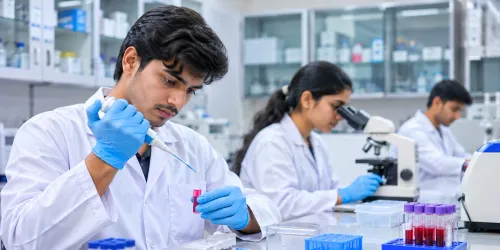
A mislabeled tube can invalidate flawless analysis, so specimen collection and identification must be practised as one procedure. Under supervision, perform venepuncture by confirming two patient identifiers against the requisition, using hand hygiene, selecting tubes in the correct order of draw, filling them to the mark, mixing gently, and labelling them at the bedside.
Manage haemolysis, prolonged tourniquet use, fainting, needlestick injury and rejected specimens. Practise capillary sampling with the correct puncture depth and pressure.
Core bench practice includes:
- Perform blood grouping and haemoglobin testing, including controls and result recording.
- Complete the complete blood count workflow: receive the EDTA sample, inspect it, mix it, check analyser flags, review abnormal results and prepare a smear.
- Prepare, stain and examine a peripheral smear; measure ESR without disturbing the column.
- Conduct urine routine microscopy for cells, casts, crystals and organisms.
- Examine stool for parasites, ova, cysts, occult blood and visible abnormalities.
- Practise clinical chemistry and serology with correct pipetting, serum separation, controls and result verification.
- Observe microbiology culture handling and basic histopathology processing without confusing specimen types or fixatives.
Test purpose changes interpretation.
| Test purpose | What you assess | Common mistake |
|---|---|---|
| Screening | Early detection in an at-risk group | Treating a screen as a diagnosis |
| Diagnostic | Evidence supporting a suspected condition | Ignoring symptoms and specimen timing |
| Confirmatory | Specific evidence after a preliminary result | Comparing with a reference interval instead of a clinical decision limit |
A credible programme uses supervised real specimens and competency checklists for collection, smear preparation, pipetting, documentation and waste segregation under the Biomedical Waste Management Rules, 2016.
How do equipment practice and microscopy build reliable observation?
A numerical reading becomes useful only when you can connect the instrument setting, specimen condition, observation and recorded result. Supervised practice lets you repeat each task, spot an error and explain its effect instead of copying a displayed value.
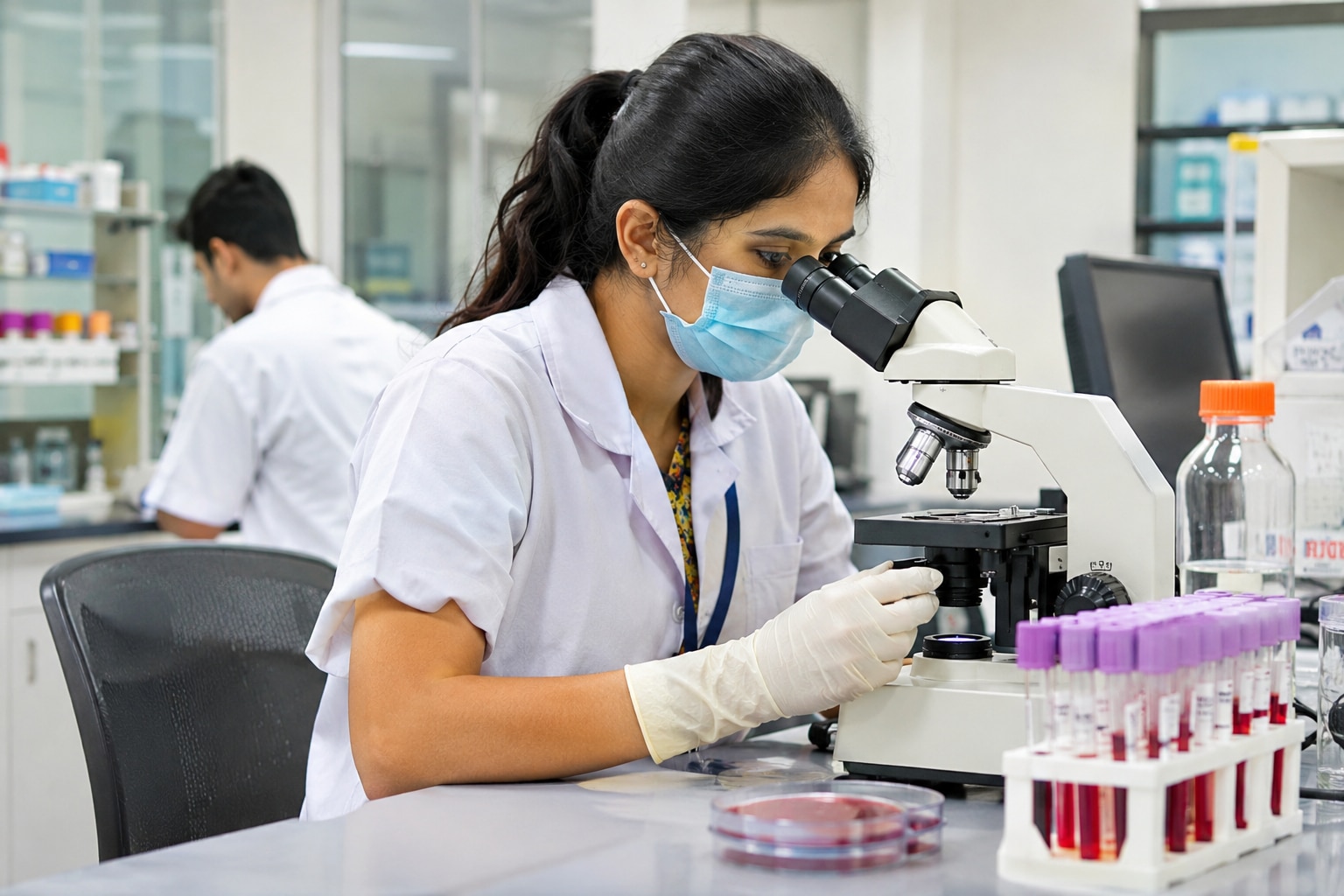
- Microscope: Practise microscope focusing and illumination, low-power and high-power scanning, oil immersion, staining and slide quality. Learn to recognise dust, folds, air bubbles, thick smears and uneven staining before calling a finding abnormal.
- Centrifuge: Balance tubes, select the correct speed and time, and separate serum, plasma or urine sediment without disturbing layers.
- Haematology analyser: Load correctly identified samples, check flags and compare unexpected counts with a smear.
- Semi-automated biochemistry analyser: Pipette standards, samples and reagents in sequence, maintain timing and recognise an implausible result.
- Glucometer: Use the correct strip, adequate capillary blood and a valid meter reading; poor sampling can produce a misleading glucose value.
- Water bath and incubator: Control temperature, timing and placement so reactions and cultures receive consistent conditions.
- Autoclave: Load safely, select the validated cycle and confirm that sterilisation indicators were processed.
- Micropipette: Set the volume, use the correct tip, pre-wet when instructed and dispense without bubbles.
In microbiology, this practice extends to aseptic inoculation, culture-media selection, incubation, colony observation and Gram staining. In basic histopathology, it supports slide handling, staining and artefact recognition. A trainee must relate findings to specimen quality and contamination, and refer uncertain observations rather than overstate them.
How do quality control, biosafety and reporting prevent laboratory mistakes?
A numerical result is not reliable because it looks precise. Internal quality control uses control materials with known values to check an analytical run, while calibration aligns an instrument or method with a defined standard. A trainee records both control results and instrument status before releasing patient results.
A Levey–Jennings chart shows whether control values remain within the laboratory’s accepted limits or develop a trend. An out-of-range control means the run needs investigation, not automatic reporting. The trainee should:
- Stop release of affected patient results.
- Check reagent expiry, storage, pipetting, instrument flags and calibration.
- Repeat the control or test after the identified problem is addressed.
- Record the finding, decision and corrective action, then escalate unresolved failures.
External quality assessment compares a laboratory’s performance with an assigned value or peer laboratories. It tests whether results remain accurate beyond the laboratory’s own internal quality control.
Biosafety prevents a result from being obtained at the cost of exposure or contamination. Training covers standard precautions, gloves and coats, sharps disposal, spill response, decontamination and exposure reporting. Under the Biomedical Waste Management Rules 2016, segregate sharps and infectious waste at the point of generation and follow the authorised treatment route.
Before reporting, verify patient identity, specimen type, units, reference interval, analyser flags and previous results. Escalate critical values to authorised clinical staff, protect confidentiality, and document corrected reports and communication.
How can you judge whether a DMLT programme in PCMC provides real practical competence?
A tour of a teaching laboratory proves almost nothing. Before enrolling, ask for documents showing who awards the qualification, which body recognises it, and whether employers or the relevant state registration authority accept it. DMLT eligibility and recognition can differ between institutions even when the course title is identical.
| Check | Evidence to request | Warning sign |
|---|---|---|
| Clinical training | Dates, departments and hours for clinical laboratory rotations in specimen collection, haematology, biochemistry, microbiology, pathology and transfusion work | Only demonstrations or a room described as a “lab” |
| Supervision | Named supervisors and records of observed procedures | Practice claimed without clinical sign-off |
| Competence | A competency record covering venepuncture, smear preparation, staining, pipetting, quality-control review and waste segregation | Attendance certificate used as proof of skill |
| Specimen handling | Assessments covering identification, labelling, rejection, transport and disposal | No task-based assessment |
| Records | Practice entering identifiers, tracking samples and documenting rejected specimens in a laboratory information system; inspect manual-register exercises too | No audit trail or confidentiality procedure |
Ask to see a blank competency checklist and one completed sample, with personal details removed. The assessment should require you to perform and document a task, not merely watch it.
An ISO 15189 quality system describes exposure to laboratory quality practices; it does not mean the course is accredited. Accreditation applies to a medical laboratory and its defined test scope, not automatically to the training programme or its graduates.
KP PARAMEDICAL INSTITUTE PCMC is worth comparing on these records, supervision and career-support evidence rather than on its title alone.
Related product
 | Best DMLT Course The DMLT (Diploma in Medical Laboratory Technology) at KP Paramedical Institute PCMC is a career-focused paramedical program designed to prepare... View product → |
Frequently asked questions
What happens to a specimen from requisition to disposal?
The workflow runs from test requisition and patient identification through collection, labelling, transport, accessioning, testing, result verification, reporting and safe disposal. Each hand-off needs a traceable record.
Which specimen collection and bench skills must DMLT students practise?
Core practice includes patient identification, venipuncture, correct tube selection, labelling, urine and other specimen handling, centrifugation, pipetting, slide preparation, staining and contamination prevention.
How do equipment practice and microscopy build reliable observation?
Repeated work with centrifuges, microscopes, pipettes and analysers teaches correct setup, focusing, measurement, calibration checks and recognition of artefacts before observations are recorded.
How do quality control, biosafety and reporting prevent laboratory mistakes?
Internal quality controls reveal analytical problems, biosafety procedures reduce exposure and contamination, and result verification checks units, reference ranges, critical values and transcription before reporting.
How can you judge whether a DMLT programme in PCMC provides real practical competence?
Ask how many supervised lab hours students complete, which specimens and instruments they handle, how competency is assessed, whether quality-control records are used and whether students practise the full workflow from receipt to disposal.