

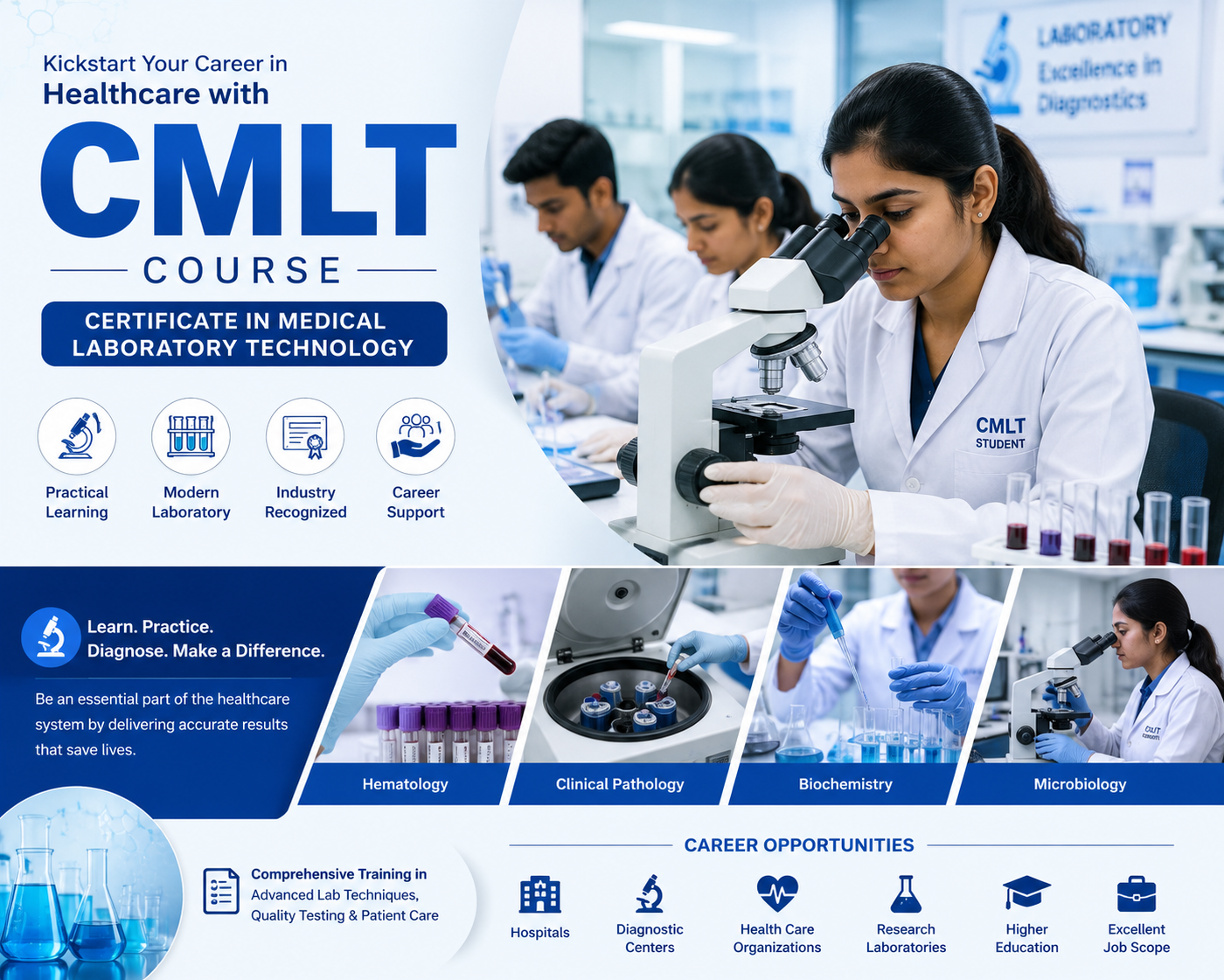
Certificate-level paramedical education is often considered by students who want an introductory understanding of laboratory support work. A CMLT course can familiarise learners with basic laboratory processes, safety practices and the responsibilities associated with handling clinical samples.
CMLT commonly refers to a Certified Medical Laboratory Technician or Certificate in Medical Laboratory Technology course, depending on the institution and awarding structure. Students exploring a CMLT course in PCMC should confirm the exact title and validity of the qualification rather than relying only on its abbreviation. KP Paramedical Institute can provide program-specific details to help applicants understand what the available course includes.
What Students Generally Learn in CMLT
A CMLT curriculum usually introduces foundational laboratory concepts rather than the broader academic depth associated with a degree. The subjects and practical components may vary, but students are commonly introduced to:
- Basic anatomy and physiology
- Clinical laboratory terminology
- Sample collection and labelling
- Introduction to haematology
- Basic urine and blood-testing procedures
- Laboratory equipment awareness
- Infection prevention
- Personal protective equipment
- Biomedical waste disposal
- Record maintenance
The purpose is to build basic technical awareness and prepare learners to perform suitable support tasks under supervision.
Understanding the Level of the Course
One of the most important admission checks is the course level. A certificate, diploma and degree are not interchangeable qualifications.
A certificate course is generally narrower in scope and may be shorter than a diploma or degree. This can make it useful as an introductory option, but it may also affect job eligibility and future academic progression.
Students should ask:
- Is CMLT offered as a certificate or another qualification?
- Who issues the final certificate?
- Is the program recognised for the intended employment purpose?
- Which tasks may graduates be eligible to perform?
- Can the qualification be used for further studies?
- What practical exposure is included?
Clear answers will help prevent confusion after admission.
Habits That Matter in Laboratory Training
Successful laboratory learning depends on professional habits as much as scientific knowledge. Students should be prepared to follow instructions exactly, keep workspaces organised and report errors immediately.
Important habits include:
- Correct identification: Every sample must be matched with the appropriate information.
- Clean handling: Work surfaces, instruments and protective equipment must be managed responsibly.
- Accurate documentation: Observations and assigned data should be recorded clearly.
- Safe disposal: Used materials must be segregated according to relevant safety procedures.
- Confidentiality: Patient and test information should be treated responsibly.
- Timely communication: Problems with samples or equipment must be escalated to the appropriate supervisor.
These practices help students understand why discipline is central to diagnostic work.
Possible Work Environments
Based on the qualification’s recognition and an employer’s requirements, CMLT learners may explore appropriate support opportunities in:
- Small and medium diagnostic laboratories
- Hospital laboratory departments
- Pathology collection centres
- Clinics with testing facilities
- Sample collection services
- Healthcare screening facilities
Candidates should read job descriptions carefully. The title “laboratory technician” may involve different responsibilities across organisations, and some positions may require a diploma, degree, registration or prior experience.
Choosing a CMLT Program in PCMC
Students in Pimpri-Chinchwad benefit from access to educational institutions and a growing healthcare ecosystem within Maharashtra. Even so, location should be considered alongside training quality.
Visit the institute before paying fees and observe whether the laboratory is organised, whether safety procedures are explained and whether practical sessions form a genuine part of the timetable. Ask to see the current syllabus, fee structure and certification details in writing.
A CMLT course can be a practical starting point for learners interested in medical laboratory work. Choosing carefully will help PCMC students understand the qualification’s actual value, limitations and potential role in their future education or employment.